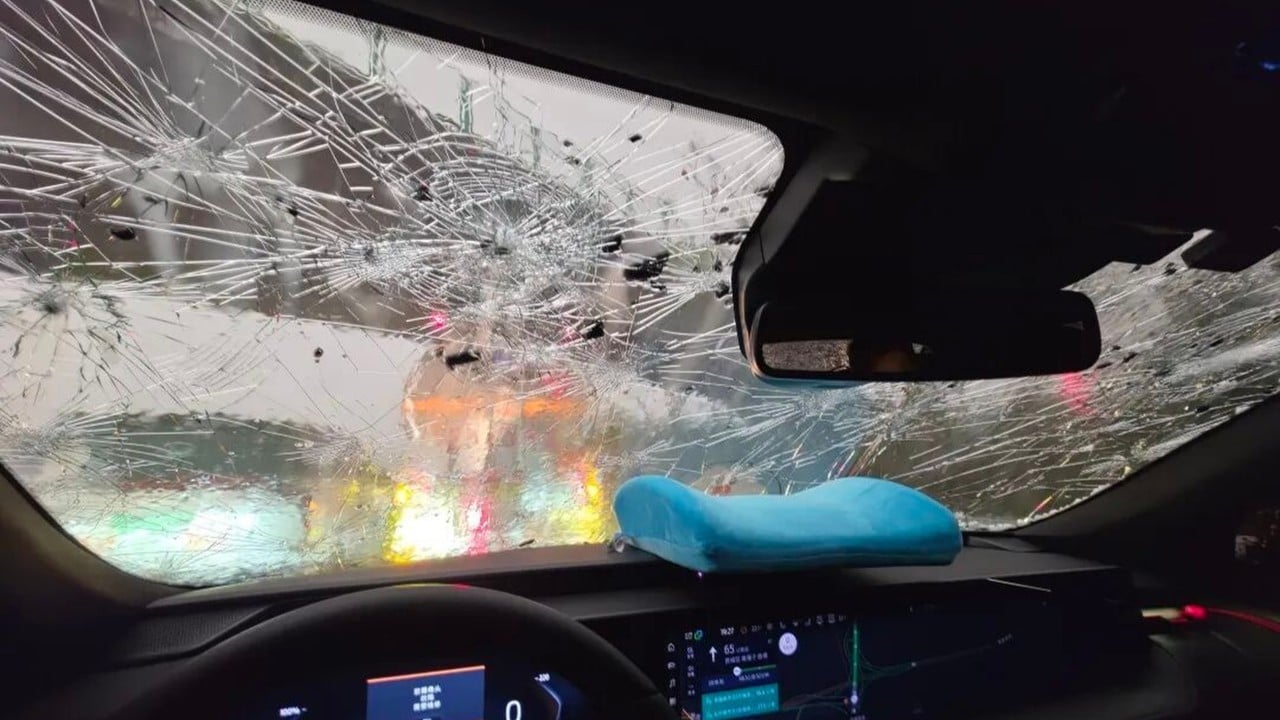
The convergence of high-density aviation hubs and intensifying mesoscale convective systems creates a failure state that traditional scheduling cannot absorb. When a hailstorm strikes an airport like Chengdu Shuangliu International (CTU), the operational breakdown is not merely a weather delay; it is a systemic collapse of three distinct layers: airside infrastructure integrity, fleet airworthiness, and the logic of hub-and-spoke recovery. The recent extreme weather event in Southwestern China serves as a case study in how localized atmospheric energy translates into massive logistical friction.
The Kinematics of Hail Damage in High-Velocity Environments
Hail damage to commercial aircraft is a function of kinetic energy ($E_k = \frac{1}{2}mv^2$) where $m$ is the mass of the ice stone and $v$ is the relative velocity of impact. While the aircraft is stationary on the tarmac, the velocity is dictated by the terminal velocity of the falling hail. However, the damage threshold for an airframe is significantly lower than for reinforced ground structures.
Component Vulnerability Hierarchy
The structural impact of a hailstorm is stratified across the airframe based on material composition and surface orientation:
- Radomes and Composite Fairings: These are often the first points of failure. Because radomes must be transparent to radar signals, they are constructed from glass-fiber reinforced plastics or honeycomb composites rather than aluminum. Large hail causes delamination or punctures, rendering the weather radar and navigation systems inoperable.
- Leading Edge Slats and Flaps: These surfaces are precision-engineered for laminar flow. Even micro-indentations (dimpling) disrupt aerodynamic efficiency, potentially leading to increased fuel burn or, in severe cases, stall speed variability.
- Engine Turbofans: While modern high-bypass turbofans are tested for ice ingestion, stationary engines are vulnerable to "Foreign Object Debris" (FOD) dynamics if hail accumulates in the intake or damages the spinner cone.
- Control Surfaces: High-energy impacts on elevators and ailerons can jam mechanical linkages or damage the hydraulic actuators housed within the wings.
The Economic Cost Function of Grounding a Regional Hub
Chengdu functions as the primary gateway to Western China, operating as a "fortress hub" for several domestic carriers. When a hailstorm forces a total ground stop, the financial hemorrhage follows a non-linear path.
The Opportunity Cost of Slot Expiry
In high-density airports, a "slot" is a perishable asset. A ground stop does not simply shift the schedule forward; it creates a "logistical debt" that grows as long as the storm persists. The cost function involves:
- Crew Duty Limits: Pilots and cabin crew operate under strict regulatory fatigue mandates. A four-hour hailstorm delay often pushes crews past their legal "on-duty" window, requiring the carrier to find replacement crews that may not be stationed at the hub.
- Downstream Cascades: An aircraft grounded in Chengdu is an aircraft that cannot perform its scheduled legs in Shanghai, Beijing, or Shenzhen. The "tail-routing" disruption means a single hailstorm in the Southwest can cause cancellations 2,000 kilometers away.
- Maintenance Man-Hours: Following a severe hail event, every aircraft on the apron must undergo a "Level 2" structural inspection. This requires specialized NDT (Non-Destructive Testing) equipment and a surge in maintenance personnel that most hubs are not staffed to handle simultaneously.
Meteorological Mechanics: Why the Sichuan Basin is a High-Risk Zone
The Sichuan Basin's geography creates a unique "pressure cooker" effect. Moist air from the south is trapped by the surrounding mountain ranges, leading to rapid vertical development of cumulonimbus clouds.
The Supercell Lifecycle in Southwestern China
The hailstorm that impacted Shuangliu was likely the result of an "Overshooting Top" scenario. In these systems, the updraft is so powerful that it penetrates the tropopause, allowing ice crystals to cycle through the freezing layer multiple times. Each cycle adds a layer of ice, increasing the stone's mass until the updraft can no longer support it.
The resulting "hail shaft" produces a localized microburst—a column of sinking air that hits the ground and spreads out at high speeds. This creates a dual threat: physical impact from the ice and extreme wind shear that threatens any aircraft in the takeoff or landing phase.
The Failure of Predictive Modeling in Terminal Area Forecasts (TAF)
While satellite imagery can track large-scale fronts, the exact cell that produces damaging hail is often a sub-mesoscale event. Standard Terminal Area Forecasts (TAF) often struggle with the "Lead Time vs. Accuracy" trade-off.
If an airport issues a "Red Alert" too early, it triggers unnecessary and expensive diversions. If it issues it too late, aircraft are caught on the ground or, worse, on final approach. The Chengdu event highlights a gap in real-time "Nowcasting" where Doppler radar data must be integrated into automated ground-handling systems to trigger immediate protective measures, such as moving high-value assets into hangars or adjusting the orientation of parked aircraft to minimize frontal impact.
The Infrastructure Bottleneck: Hangar Capacity vs. Fleet Size
A fundamental weakness in modern aviation strategy is the ratio of aircraft to protected hangar space. At a major hub like Chengdu, only a small fraction of the based fleet can be sheltered.
The Triage Logic of Asset Protection
When a severe weather warning is issued, airport operations must engage in a triage process:
- Priority 1: Wide-body International Assets. These represent the highest capital investment and the most difficult parts to source for repairs.
- Priority 2: Aircraft with Open Maintenance Items. If an aircraft already has its cowlings open or panels removed, it is exponentially more vulnerable to water and ice damage.
- Priority 3: Narrow-body Domestic Fleet. These are often left exposed on the apron due to sheer volume.
This hierarchy ensures that the most expensive assets are protected, but it guarantees that the domestic "workhorse" fleet will bear the brunt of the damage, leading to the widespread cancellations seen during the Chengdu event.
Logistics of the Recovery Phase
The "re-opening" of an airport after a hailstorm is a misnomer. The runway may be clear, but the system remains paralyzed.
FOD Clearance and Runway Integrity
Before any takeoff can occur, the airport must perform a sweep for Foreign Object Debris. Hailstones themselves melt, but the impact often dislodges pieces of runway lighting, sealant, or aircraft debris. A single piece of metal sucked into a jet engine during a high-speed takeoff roll is catastrophic.
The Passenger Displacement Logarithm
For every hour an airport is closed, the time required to re-accommodate passengers increases exponentially.
- Linear Growth: Initial hour of delay = 1:1 recovery.
- Exponential Growth: After hour four, missed connections and crew timeouts create a backlog that can take 48 to 72 hours to clear.
The bottleneck is not the number of planes, but the "re-accommodation capacity" of the gate agents and the digital booking systems. When 50 flights are cancelled simultaneously, the surge in web traffic often crashes the airline’s mobile interface, forcing passengers into physical queues and further slowing the recovery.
Strategic Hardening of Aviation Hubs
To mitigate the impact of future convective events in the Sichuan Basin and beyond, the industry must move toward a "Resilient Hub" model. This does not mean building hangars for every plane, but rather implementing "Active Defense" strategies.
- Deployable Airframe Shielding: Research into lightweight, high-impact polymer covers that can be quickly deployed over cockpits and radomes during ground stays.
- AI-Integrated Nowcasting: Moving beyond human-read TAFs to direct machine-to-machine alerts that automatically halt fueling and boarding operations the moment a hail core is detected within a 20-kilometer radius.
- Distributed Hubbing: Reducing the reliance on a single mega-hub like Shuangliu by developing secondary "relief" airports with full maintenance capabilities (e.g., Chengdu Tianfu).
The Chengdu hailstorm was not a "black swan" event; it was a predictable outcome of geographical risk meeting infrastructure density. The current strategy of "wait and repair" is no longer viable in an era of increasing atmospheric volatility. The focus must shift from reactive maintenance to proactive structural and digital hardening.