The humidity in the Lo Wu checkpoint always smells the same. It is a thick, metallic scent composed of thousands of damp raincoats, the ozone of turnstiles, and the frantic, quiet energy of people in a hurry to be somewhere else. For decades, this crossing was a functional necessity, a drab portal between the colonial ghosts of Hong Kong and the industrial grit of Shenzhen. But during this past Easter break, the air felt different. The rhythm of the footfalls had changed.
People weren't just crossing to buy cheaper groceries or knock-off sneakers. They were chasing a glimpse of a future that has arrived faster than anyone in the SAR expected. Meanwhile, you can explore related developments here: Your Frequent Flyer Miles Are Liability Not Loyalty.
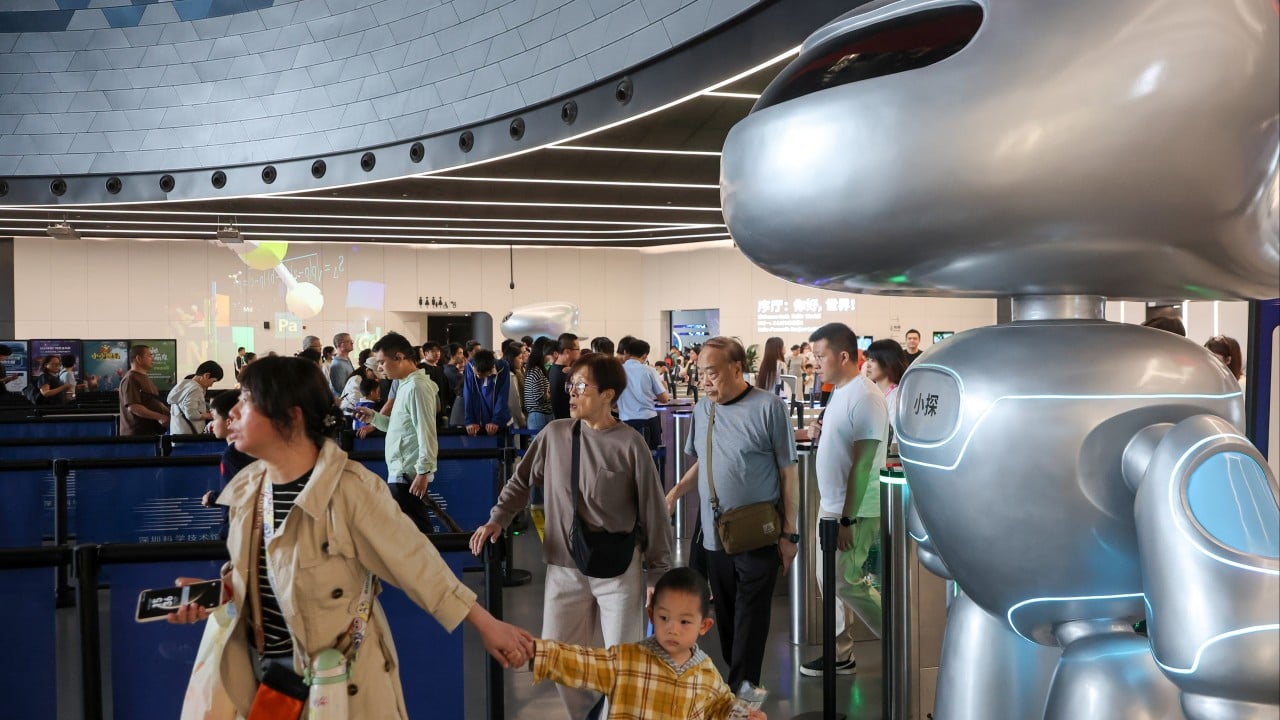
Consider a man like Mr. Lam. He is sixty-four, a retired civil servant from Tai Po who remembers when Shenzhen was mostly duck ponds and rice paddies. He spent his Easter Saturday clutching a digital ticket on his smartphone, standing in a queue that snaked around the shimmering curves of the new Shenzhen Museum of Contemporary Art and Urban Planning. He wasn't there for the art. He was there for the "Shenzhen Science and Technology Exhibition," a massive, multi-sensory display that has become the unlikely star of the holiday season.
Lam didn't go alone. He brought his grandson, a teenager who usually spends his weekends locked in a digital trance of mobile gaming. For the first time in years, the boy’s eyes weren't on his own screen. They were fixed on a six-axis robotic arm performing a surgical procedure with the delicacy of a concert pianist. To see the full picture, check out the detailed report by The Points Guy.
The Gravity Shift
There is a specific kind of vertigo that comes from realizing the neighborhood you once looked down upon has become the one you now look up to. For the hundreds of thousands of Hongkongers who streamed across the border over the long weekend—official figures estimated over 1.5 million departures across all land ports—the primary draw was the sheer scale of the change.
In Hong Kong, space is a luxury. Every square foot is a battleground. Innovation often feels like an incremental struggle against high rents and old infrastructure. Step across the Shenzhen River, however, and the scale shifts. The new tech museum is a cavernous cathedral of steel and glass, a place where "big" is the baseline.
The crowd wasn't just there to see gadgets. They were there to witness a narrative of competence. When Lam saw the drone swarm display—hundreds of synchronized lights dancing in a choreographed ballet—it wasn't just the LED brightness that struck him. It was the realization that the software driving those lights was birthed just a few kilometers from where he stood.
The stakes are invisible but heavy. For a Hong Kong family, visiting a tech museum in Shenzhen is a reconnaissance mission. They are looking at the jobs their children might hold, the cars they might drive, and the way their lives will be tracked, optimized, and displayed.
The Tactile Future
The brilliance of the exhibition lies in its refusal to be a static gallery. It is a playground of haptic feedback and real-time data. One section allows visitors to sit in a cockpit and "drive" a vehicle located in a testing facility on the outskirts of the city via a 5G link.
A young woman from Sha Tin, let’s call her Chloe, sat in that chair. She is twenty-four, working a dead-end marketing job, and has spent most of her life hearing that Hong Kong is the "World's City." As she moved the steering wheel and watched the low-latency video feed react instantly, she felt a pang of something that wasn't quite jealousy, but closer to a sudden, sharp clarity.
The "lag" she expected wasn't there. The delay between her movement and the machine’s response was less than thirty milliseconds. In that tiny sliver of time, a decade of assumptions about regional superiority evaporated.
This is the psychological core of the Easter exodus. It is the search for a friction-less existence. Hongkongers are famously efficient, yet their daily lives are often bogged down by legacy systems—physical coins, paper receipts, and transit cards that feel increasingly like relics. In the museum, and the malls surrounding it, everything is a scan, a face, a whisper of data.
The Quiet Hunger for Wonder
We have become cynical about "innovation." The word has been drained of its blood by corporate brochures and government press releases. But wonder is a different animal. Wonder is what happens when a five-year-old sees a humanoid robot mimic their facial expressions in real-time.
During the Easter break, the museum’s interactive AI zone was a riot of noise. Children weren't being lectured to; they were playing with Large Language Models that could turn their scribbles into oil paintings or their humming into orchestral scores.
There is a profound human need to feel that the future is something we are building, rather than something that is simply happening to us. For many visitors, the exhibition offered a sense of participation. They could see the "Smart City" dashboard of Shenzhen—a sprawling digital twin of the metropolis that monitors everything from water pressure in the pipes to the exact location of every electric bus.
It is terrifying to some. To others, it is the ultimate expression of order.
The museum doesn't hide the data. It celebrates it. It shows the heartbeat of the city in glowing blue lines. For a visitor from the chaotic, cramped streets of Mong Kok, there is a seductive peace in that level of control.
The Reversal of the Current
For years, the flow of influence went one way. Hong Kong was the teacher, the financier, the window to the world. Shenzhen was the factory floor.
The Easter crowds represent a reversal of that current. The "tech museum" isn't just a building; it is a symbol of the moment the factory floor became the laboratory.
Families sat in the museum’s canteen, eating meals delivered by ceiling-mounted rails or small autonomous carts, discussing not the price of the food, but the logic of the delivery system. The conversation has moved from "What can we buy there?" to "How do they do that there?"
The invisible stakes are found in the silence of the high-speed rail ride back home. Passengers stare out the window at the skyline of Futian, which glows with a coordinated light show that makes the skyscrapers look like giant, pulsing circuit boards.
Mr. Lam watched his grandson on the train ride back. The boy was no longer playing his game. He was searching for the specs of the surgical robot he had seen. He was reading about degrees of freedom and carbon-fiber actuators.
The boy asked if they could go back next month. Lam nodded, looking at his own hands—hands that had worked a lifetime in a city that is now wondering where its next act will come from.
The border is still there. The IDs are still checked. The two currencies still exist. But the glass screen between the two worlds is thinning. It is becoming a mirror. When the people of Hong Kong look across the river now, they aren't looking at a neighbor. They are looking at a version of themselves that moved into the future while they were still waiting for the light to change.
Outside the museum, the sun set over the Civic Center, casting long shadows of the giant red and yellow "Sails" that crown the building. Thousands of visitors streamed out, their faces illuminated by the glow of their phones as they called for ride-shares that arrived in minutes, driven by cars that hummed with electric silence. They carried with them a strange, heavy gift: the knowledge that the world they knew is gone, and the one that replaced it is far more beautiful, and far more demanding, than they ever imagined.
The metallic smell of the Lo Wu checkpoint waited for them on the return journey, but the people inside the trains were no longer the same. They were carrying the spark of a different fire.