The scream of an incoming missile doesn't just signal a single explosion anymore. In southern Lebanon, it's the start of a countdown. On Tuesday, April 28, 2026, that countdown ended in the deaths of three Lebanese Civil Defense rescuers in the town of Majdal Zoun. They didn't die in the first blast. They died when they rushed in to save those who did.
This isn't an isolated accident or "collateral damage" in a chaotic skirmish. It's a calculated, brutal tactic known as the "double-tap" strike. You hit a target, wait for the first responders to arrive, and then you hit the same spot again. It turns a rescue mission into a death trap.
The Majdal Zoun Massacre
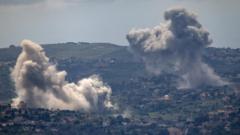
The sequence of events in Majdal Zoun followed a chillingly predictable pattern. An initial Israeli strike leveled a building in the early afternoon. As the dust settled, the Lebanese Civil Defense—a state-run, neutral rescue force—dispatched teams to dig for survivors. They weren't alone. A Lebanese Army patrol was also on the scene, providing security for the rescue efforts alongside civilian bulldozers.
Then the second strike hit.
The blast didn't just kill; it buried. Three rescuers were initially reported trapped under the rubble of the very building they were trying to clear. By the time their colleagues could reach them, they were dead. Two civilians also lost their lives in the attack, and two Lebanese Army soldiers were wounded.
Think about the psychology behind this. When you target a rescue crew, you're not just killing three people. You're telling every other paramedic in the country that their uniform is a bullseye. You're telling the family under the rubble that nobody is coming to save them because the price of helping is death.
A War Without Red Lines
Lebanese Prime Minister Nawaf Salam didn't mince words, calling the incident a "heinous crime" and a "blatant war crime." He's right. Under international law, medical and rescue personnel are protected. They're non-combatants. But in the current conflict, which escalated sharply on March 2, 2026, those protections seem to have evaporated.
Since the start of this round of fighting, the Lebanese Health Ministry reports that over 100 medics have been killed. That’s a staggering number. We're seeing a shift where humanitarian workers are no longer incidental casualties—they're becoming the primary targets of secondary strikes.
Earlier in April, we saw an even more extreme version in Mayfadoun, where a "triple-tap" or "quadruple-tap" operation killed four paramedics. The drone footage from those scenes is horrific. You see rescuers loading a bloodied colleague into an ambulance, only for a missile to slam into the pavement right next to them. One of the men killed in that strike, Fadel Sarhan, was a 43-year-old father who used to bring pet food from Beirut to feed stray cats in his village. He was a guy who spent his free time caring for animals and his professional time saving people. Now, he's a statistic.
The Ceasefire That Isn't
The most frustrating part? This is all happening while a US-mediated ceasefire is technically in place. Both Israel and Hezbollah have been trading accusations of "violations" for weeks, but for the people on the ground in southern Lebanon, the distinction between a truce and a full-scale war is meaningless.
Israel claims its strikes are surgical, aimed at dismantling Hezbollah’s Radwan Force infrastructure. They point to the discovery of massive tunnel networks—some over a kilometer long, equipped with showers, kitchens, and assembly halls under schools and mosques—as justification for their presence. But you can't justify a strike on a clearly marked rescue team by pointing at a tunnel three towns over.
The Lebanese Army, which has largely stayed on the sidelines of the direct combat between Israel and Hezbollah, is now finding itself in the crosshairs. The wounding of two soldiers in Majdal Zoun marks one of the first times the national army has been directly targeted since the April 17 truce began. This isn't just a "border flare-up" anymore. It's a systematic degradation of the state’s ability to function.
The Cost of Inaction
What happens when you kill the rescuers? You get what we saw last week with the death of a Lebanese journalist. He was trapped under rubble after a strike, and his colleagues couldn't get to him. Why? Because the Israeli drones were still circling, and everyone knew the second tap was coming. He died because the risk of saving him was a death sentence for the rescue team.
- Infrastructure Decay: Hospital response stations have been reduced to tents because the actual buildings have been demolished.
- Psychological Terror: Paramedics now have to decide if a "distress call" is actually a lure.
- Civilians Abandoned: Tens of thousands remain in the south because they have nowhere else to go. When the rescuers are targeted, these people are truly on their own.
International human rights groups like Human Rights Watch are sounding the alarm, but the rhetoric feels empty. When 100+ medics die in two months and the response is a "call for restraint," the message is clear: the rules don't apply here.
The "double-tap" isn't just a military tactic. It's a moral failure. It targets the very best instinct of humanity—the urge to help someone in need—and uses it as a weapon.
If you want to support those on the front lines, look into the Lebanese Red Cross or independent civil defense funds. They're the ones still heading into the smoke, knowing full well that another missile might be seconds away. Stop waiting for the "official" ceasefire to mean something and start acknowledging that for Lebanese first responders, the war never paused.