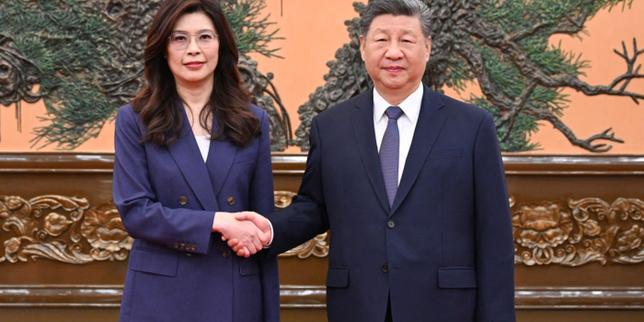
Taiwan's political ground is shifting under our feet. For decades, the narrative was simple. You had the Democratic Progressive Party (DPP) pushing for a distinct Taiwanese identity and the Kuomintang (KMT) clinging to the idea of one China, even if their version looked nothing like Beijing's. But things aren't that simple anymore. The KMT is currently re-engineering its entire approach to cross-strait relations, and they're doing it under the banner of peace.
If you've been watching the news, you've seen the headlines. High-level delegations from the KMT are making frequent trips to the mainland. They're shaking hands with officials who the current Taiwanese government won't even speak to. It's a gamble. It’s a massive, high-stakes play to convince the Taiwanese public that the only way to avoid a catastrophic war is to play ball with the Chinese Communist Party (CCP).
The Peace Narrative Is a Powerful Weapon
The KMT’s current strategy relies on one primary emotion: fear. Nobody wants a war. Watching what happened in Ukraine or Gaza makes the prospect of a conflict in the Taiwan Strait feel visceral and terrifying. The KMT knows this. They’ve positioned themselves as the only "adults in the room" capable of talking to Beijing.
When Andrew Hsia, the KMT vice chairman, travels to China, he isn't just there for tea. He's sending a message back home. That message is that the KMT can manage the dragon, while the DPP only pokes it with a stick. They argue that the DPP’s refusal to acknowledge the "1992 Consensus"—that vague agreement where both sides acknowledge there's only one China but disagree on what that means—is what’s putting Taiwan in danger.
But here’s where it gets complicated. By leaning so hard into this "peace through dialogue" stance, the KMT is moving closer to Beijing’s preferred talking points than ever before. They aren't just talking about trade anymore. They're talking about a shared cultural and ethnic "Chinese" identity. That's a dangerous game when a majority of people on the island now identify as Taiwanese, not Chinese.
Why the Opposition Is Risking Everything
You might wonder why a party would align itself with an authoritarian neighbor that regularly sends fighter jets into its airspace. It’s about survival—both for the party and, in their view, the island. The KMT sees the current status quo as a slow-motion train wreck. They look at the economic pressure China is applying and the military drills surrounding the island and see an inevitable conclusion if things don't change.
Their logic is pretty straightforward. If they can lower the temperature, the economic benefits will follow. They want to revive the Cross-Strait Service Trade Agreement (CSSTA), a deal that sparked the Sunflower Movement protests back in 2014. They believe Taiwan’s economic future is inextricably linked to the mainland, and trying to decouple—as the US and the DPP suggest—is economic suicide.
However, this isn't just about money. There's a deep-seated belief among the KMT old guard that Taiwan and China belong together in some form. Not necessarily under the CCP’s thumb, but as part of a broader Chinese civilization. This puts them at odds with the younger generation who grew up in a vibrant democracy and see China as a foreign threat, not a long-lost cousin.
The 1992 Consensus Is a Ghost That Won't Die
You can’t talk about Taiwan politics without hitting the 1992 Consensus. It’s the bedrock of KMT policy. For years, it worked as a "strategic ambiguity" tool. It allowed both sides to trade and talk without settling the impossible question of sovereignty.
But Xi Jinping changed the rules. In 2019, he explicitly linked the 1992 Consensus to the "One Country, Two Systems" model—the same one used in Hong Kong. After the world saw what happened to Hong Kong’s autonomy, that became a toxic association in Taiwan.
The KMT is trying to perform a miracle. They’re trying to sell the 1992 Consensus to a skeptical public while insisting it doesn't mean they're selling out to the CCP. They call it "pro-US, friendlier to China, and peace with Japan." It’s a mouthful, and it’s a tightrope walk that gets narrower every day. If they lean too far toward Beijing, they lose the domestic elections. If they don't lean far enough, Beijing ignores them, and their "we can talk to them" selling point vanishes.
Economic Dependence vs National Security
Think about the chips. Taiwan produces the vast majority of the world's most advanced semiconductors. This "Silicon Shield" is supposed to protect the island. The KMT argues that this shield only works if there's stability. They see the DPP’s move to diversify trade away from China as weakening Taiwan’s leverage.
I’ve seen this play out in local industries. Farmers in southern Taiwan, traditionally a DPP stronghold, have been hurt by Chinese bans on pineapples and grouper fish. The KMT swoops in and says, "See? If we were in power, your products would be on shelves in Shanghai tomorrow." It’s a compelling argument for someone losing their livelihood.
But there’s a cost. Every economic link is a potential leash. If Taiwan becomes too dependent on the mainland market again, Beijing can use that as a weapon. We’ve seen them do it to Australia, Lithuania, and even the NBA. The KMT’s "peace" could easily look like a slow-motion surrender if the economic integration goes too deep without solid security guarantees.
The Generational Divide Is the KMT's Biggest Hurdle
The KMT has a demographic problem. Their base is aging. The people who remember the mainland or who feel a strong "Republic of China" identity are passing away. The new voters, the Gen Z and Millennial groups, don't care about the 1992 Consensus. They care about housing prices, low wages, and maintaining their democratic lifestyle.
To these younger voters, the KMT’s overtures to Beijing look like desperation. They see a party led by wealthy elites who are more comfortable in a Beijing ballroom than a Taipei night market. For the KMT to actually win a presidential election again, they have to convince these people that "moving closer to the line" doesn't mean falling over it.
They tried a "rebranding" under former chairman Johnny Chiang, who wanted to move away from the 1992 Consensus. It failed. The party elders and the deep-blue base revolted. So, the party is back to its traditional roots, hoping that the fear of war will eventually outweigh the fear of China.
What This Means for Global Security
If the KMT wins the next major election cycle or continues to dominate the legislature, the regional dynamic shifts instantly. Washington is currently very comfortable with the DPP. There's a clear alignment on defense and "de-risking." A KMT-led government would likely slow down some of the military reforms and arms purchases that the US is pushing for.
They would argue that buying fewer missiles and talking more is a "peace" strategy. Washington would see it as Taiwan lowering its guard. This friction would be a gift to Beijing. The CCP’s goal has always been to drive a wedge between Taipei and Washington. If they can use the KMT to do that, they don't need to fire a single shot.
How to Track What Happens Next
Watching Taiwan’s political evolution isn't just for policy wonks. It’s a masterclass in how a democracy handles an existential threat from a neighbor that is also its largest trading partner.
Pay attention to the local elections and the legislative maneuvers. If the KMT continues to push for bills that limit the president's power over foreign policy or cross-strait deals, you're seeing the "peace" strategy in action.
Don't just watch the official statements. Watch the travel itineraries. Who is going to Beijing? Who are they meeting? When you see the KMT sending people to meet with Wang Huning—the CCP’s top ideologue and the man tasked with "unification"—you know the stakes are getting higher.
The KMT isn't necessarily "pro-CCP," but they are betting that a controlled acercamiento is better than an uncontrolled conflict. Whether the Taiwanese people agree with that bet will determine the fate of the Western Pacific. Keep your eyes on the polling regarding "Taiwanese identity" versus "Both Chinese and Taiwanese identity." That’s the real scoreboard. When that number for "Taiwanese only" continues to rise, the KMT’s path to "peace" through Chinese alignment becomes a road to nowhere.