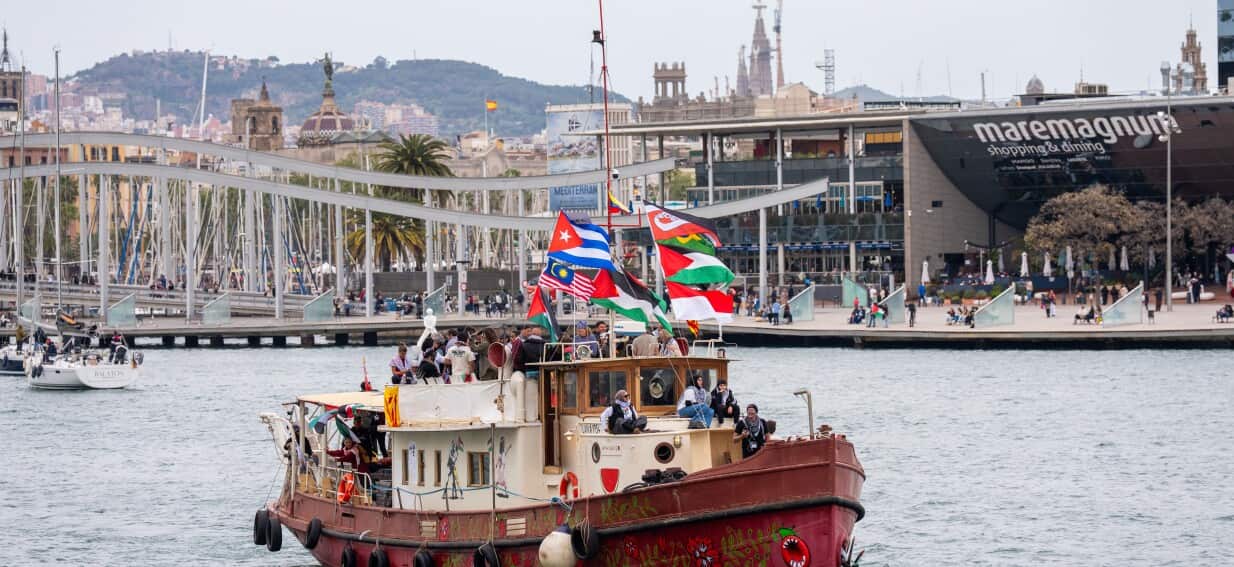
The detention of approximately 175 activists in international waters near Greece by Israeli naval forces represents a complex intersection of maritime sovereignty, kinetic interdiction logistics, and the breakdown of the San Remo Manual’s application in modern asymmetric conflict. While media reports focus on the headcount of detainees, a structural analysis reveals a calculated exercise in naval power projection designed to preempt a perceived breach of a blockade before the target vessels reach contested littoral zones. The operation's primary objective was the neutralization of a non-state maritime convoy through a high-seas boarding and search (VBSS) maneuver, a tactic that shifts the legal and operational burden from coastal defense to preemptive international interdiction.
The Triad of Maritime Interdiction Strategy
Analyzing this event requires moving beyond the narrative of "arrests" and toward a framework of strategic deterrence. The Israeli naval command likely operated under a three-pillar doctrine:
- Geospatial Preemption: By engaging the convoy near Greece—far from the Gaza coastline—the interdicting force minimizes the risk of local tactical interference and maximizes the time available to process detainees before entering high-traffic territorial waters.
- Resource Attrition: Interdicting 175 individuals simultaneously imposes an immediate logistical strain on the activist organization. The loss of hulls, communications equipment, and personnel serves as a direct tax on the movement’s future operational capacity.
- Jurisdictional Assertiveness: Carrying out an operation in international waters signals a refusal to recognize the high seas as a "safe zone" for vessels suspected of intending to violate a declared naval blockade.
The mechanism at play here is not merely law enforcement; it is a specialized form of naval blockade enforcement where the "threat" is defined not by weaponry, but by the symbolic and material payload of the activist vessels.
The Logistics of Mass Maritime Detainment
Moving 175 individuals from multiple civilian vessels to military platforms in open water is a high-risk technical exercise. The complexity of this operation is governed by a specific cost-function involving sea state, vessel displacement, and the ratio of boarding party members to detainees.
- Tactical Boarding: The use of fast-roping or specialized boarding craft (RHIBs) allows the interdicting force to secure the bridge and engine room simultaneously. This prevents the civilian crew from scuttling the vessel or engaging in "passive resistance" maneuvers that could endanger the boarding party.
- The Processing Bottleneck: Once a vessel is declared "under control," the primary constraint becomes the transfer of personnel. Standard naval vessels are not designed to house 175 non-combatants. The logistical solution typically involves a "hub-and-spoke" model: clearing individual ships and then consolidating detainees on a larger transport or primary surface combatant for transit to a secure port.
- Chain of Custody and Evidence: To justify the seizure under international frameworks, the interdicting force must document the vessel’s manifest, its GPS telemetry (to prove intent to enter blocked waters), and the presence of any dual-use materials.
This process creates a massive administrative overhead. The decision to arrest nearly 200 people suggests the Israeli Navy committed significant surface assets—likely including Sa'ar class corvettes—to manage the perimeter while specialized units handled the physical transfers.
Legal Friction in International Waters
The core controversy of this incident stems from the location: international waters. Under the United Nations Convention on the Law of the Sea (UNCLOS), vessels on the high seas enjoy freedom of navigation. However, the San Remo Manual on International Law Applicable to Armed Conflicts at Sea provides a loophole often utilized by the Israeli state.
Section V, Article 67 of the San Remo Manual suggests that merchant vessels (which includes activist ships) can be attacked or intercepted if they are believed on "reasonable grounds" to be carrying contraband or intending to breach a blockade. The legal friction arises from the definition of "intent." The Israeli position argues that once a convoy declares its destination as a blockaded zone and ignores initial warnings, its "intent" is established, making it a legitimate target for interdiction even outside the blockade zone itself.
The counter-argument, frequently held by international legal scholars, is that interdiction on the high seas constitutes an act of aggression if the blockade itself is deemed illegal or if the vessel has not yet committed a prohibited act. This creates a circular legal trap: the legality of the arrest depends entirely on the recognized legality of the blockade, a point of permanent contention in the UN Security Council.
The Political Economy of Activist Convoys
To understand why 175 individuals were present, one must analyze the activist strategy as a "saturation maneuver." Large numbers serve a dual purpose:
- Visual Mass: A higher number of detainees increases the diplomatic cost of the arrest for the interdicting state. Each country represented by a detainee must, in theory, lodge a diplomatic inquiry.
- Operational Redundancy: By distributing activists across multiple hulls, the convoy organizers force the navy to divide its forces, increasing the chance that at least one vessel might slip through or force a more violent encounter that generates global headlines.
From a consultant’s perspective, the activist organization is trading human capital for media visibility and legal pressure. The Israeli Navy is trading diplomatic capital and operational budget for the maintenance of its blockade’s integrity. The "arrest" is the point where these two balance sheets collide.
The Operational Risk of High-Seas Interdiction
While the operation was executed without reported fatalities, the risk of a "Mavi Marmara" repeat—where a 2004 interdiction led to ten deaths—remains a constant variable in the Israeli Navy’s planning. The use of non-lethal force in a maritime environment is notoriously difficult.
- Stability Factors: Boarding a vessel in a high sea state (Level 4 or above) makes non-lethal tools like water cannons or acoustic devices unpredictable.
- The Compliance Curve: The first 15 minutes of a boarding determine the outcome. If the "175" remain compliant, the operation is a success. If even 5% resist, the closed-quarters environment of a ship’s deck turns a tactical success into a strategic disaster.
This specific operation appears to have focused on overwhelming force density. By deploying a high ratio of commandos to activists, the navy ensured that resistance would be perceived as futile, thereby lowering the probability of kinetic escalation.
Strategic Forecast: The Shift to Remote Interdiction
Looking at the trajectory of these encounters, we can anticipate a move toward remote disabling technologies. Future interdictions will likely rely less on the physical boarding of 175 people and more on:
- Electronic Warfare: Disabling the navigation and communication suites of convoy vessels via localized jamming, forcing them to drift and accept a tow.
- Propulsion Fouling: Using non-destructive materials to foul the propellers of activist ships, neutralizing them without the need for a boarding party to set foot on deck.
The current model of mass arrest is resource-heavy and diplomatically expensive. The next phase of maritime control will prioritize "kinetic-light" neutralization.
The immediate strategic priority for regional maritime powers will be the establishment of a "Clearance Zone" agreement with transit countries like Greece or Cyprus. By processing activist vessels in third-party ports before they reach international waters, the Israeli state could bypass the legal and logistical nightmare of high-seas boarding. Until such a diplomatic framework is reached, the high-risk dance of international water interdiction will remain the primary tool for blockade maintenance, with the 175 activists serving as the latest data point in a long-standing war of attrition.