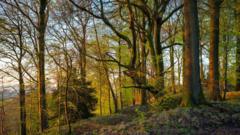
Biodiversity loss is an existential constraint on global economic stability, yet current conservation efforts often fail because they treat nature as a collection of static assets rather than a dynamic system of energy flows and biological feedback loops. The concept of nature recovery zones, popularized by environmental advocates like Sir David Attenborough, represents a transition from fragmented protectionism to systemic connectivity. To succeed, these zones must be engineered around three structural variables: habitat permeability, trophic complexity, and the marginal cost of land-use conversion.
The Connectivity Constraint and the Theory of Island Biogeography
Small, isolated nature reserves suffer from the "island effect," where local extinction rates eventually outpace colonization rates due to genetic drift and lack of migratory ingress. Nature recovery zones attempt to solve this by creating corridors that effectively increase the functional area of a habitat without requiring the acquisition of contiguous land.
The efficacy of a recovery zone is defined by the Permeability Index ($P$)$. This is the probability that an individual organism can traverse a non-protected landscape between two core habitats. In a binary conservation model (protected vs. unprotected), $P$ often approaches zero for specialist species. High-authority restoration strategy requires transforming "gray" infrastructure—farmland, suburban fringes, and industrial corridors—into semi-permeable buffers. This reduces the edge effect, where the perimeter of a habitat is degraded by external stressors like chemical runoff or invasive species encroachment.
The Trophic Cascade as a Force Multiplier
Most restoration articles focus on planting trees, which is a bottom-up approach with a slow ROI. Rigorous ecological strategy prioritizes the restoration of top-down pressures, specifically through the reintroduction of keystone species. This creates a trophic cascade, a process where the presence of a predator regulates the population and behavior of herbivores, which in turn allows vegetation to recover without manual intervention.
The Feedback Loop of Apex Predators
- Predation Pressure: Predators reduce overgrazing by cervids (deer) or other large ungulates.
- Behavioral Modification: The "landscape of fear" forces herbivores to avoid certain areas, such as riverbanks, allowing riparian vegetation to stabilize soil.
- Hydrological Stability: Increased vegetation along waterways slows flow, reduces erosion, and increases groundwater recharge.
- Carbon Sequestration: Healthy, multi-tiered forest and grassland structures capture significantly more carbon than monocultural timber plantations.
The strategic failure of many recovery zones is the omission of these "biological engineers." Without them, the zone remains a high-maintenance garden rather than a self-sustaining ecosystem.
The Economic Barrier: Opportunity Cost and Land-Use Competition
Establishing recovery zones is not a biological problem; it is an economic optimization problem. The primary hurdle is the Opportunity Cost of Land ($C_{opp}$)$. In regions dominated by intensive agriculture, the cost of retiring land for nature recovery is the net present value of the crop yield over a 30-to-50-year horizon.
To bypass this, strategy must shift toward stacked ecosystem services. This model monetizes the recovery zone through multiple revenue streams:
- Biodiversity Net Gain (BNG) Credits: Selling credits to developers to offset habitat destruction elsewhere.
- Carbon Sequestration Payments: High-integrity credits based on soil organic carbon (SOC) and biomass.
- Hydrological Services: Utility companies paying for natural upstream filtration to reduce the cost of chemical water treatment downstream.
The bottleneck in this financial model is the lack of standardized metrics. While carbon is easily quantified in tonnes, "biodiversity" lacks a singular unit of measurement. The emergence of environmental DNA (eDNA) sampling offers a technical solution, providing a high-resolution snapshot of species presence from simple soil or water samples, thereby creating a verifiable audit trail for investors.
Infrastructure Integration: The Hard-Surface Challenge
Linear infrastructure—roads, railways, and pipelines—acts as a hard barrier to nature recovery. A recovery zone that does not address transportation networks is merely a series of traps. The analytical solution is the deployment of Green Bridges and Eco-ducts, engineered to mimic the local environment.
The design of these structures must account for "species-specific deterrence." For example, many small mammals will not cross a bridge if it lacks sufficient cover from avian predators, while large mammals require specific widths to avoid feeling "funneled." The capital expenditure (CAPEX) for these structures is high, but when integrated into the initial design phase of national infrastructure projects, the marginal cost is significantly lower than retrofitting.
The Data-Driven Monitoring Framework
The shift from "observation" to "analysis" in nature recovery requires a sensor-led approach. Reliance on manual surveys is too slow and geographically limited. A robust recovery zone utilizes a three-tier monitoring stack:
- Satellite Remote Sensing: Monitoring canopy cover, moisture levels, and land-use changes over large areas.
- Acoustic Monitoring: Using AI to identify bird and insect species by their calls, providing a proxy for ecosystem health.
- eDNA and Ground Sensors: Measuring soil health, nutrient cycles, and cryptic species presence.
This data creates a digital twin of the recovery zone, allowing land managers to run predictive simulations. If a specific patch of forest shows signs of drought stress via satellite imagery, water management strategies can be adjusted before the mortality rate of saplings spikes.
Strategic Realignment: From Preservation to Resilience
The fundamental flaw in historical conservation is the "museum model"—the attempt to freeze an ecosystem in a specific historical state. This is impossible under current climate volatility. True nature recovery zones must be designed for Adaptive Resilience. This means selecting species mixes that are projected to thrive in the climate of 2050, not 1950.
This requires a "assisted migration" framework, where species are proactively moved into new recovery zones as their historical ranges become uninhabitable. While controversial among traditionalists, it is the only logically sound approach to maintaining functional ecosystems in a rapidly warming biosphere.
The path forward requires the immediate cessation of pilot projects in favor of integrated regional planning. We must move toward a Spatial Bio-Economic Plan that maps core habitats and identifies "high-leverage corridors" where a small land-use change yields a disproportionately large increase in habitat connectivity. Investment must be diverted from low-impact tree planting initiatives toward the acquisition of these strategic corridors. The success of nature recovery zones will not be measured by the number of trees planted, but by the measurable increase in species richness and the stabilization of ecosystem service outputs across the landscape.