The wind off the Gulf of Aden doesn't just carry the scent of salt; it carries the weight of history and the silent vibrations of a changing world order. In the dusty, sun-scorched streets of Hargeisa, the capital of Somaliland, there is a sense of waiting. It is a place that exists in a strange geopolitical limbo—a state that functions with its own currency, its own military, and its own democratic elections, yet remains largely invisible on the official maps of the United Nations.
But visibility is changing.
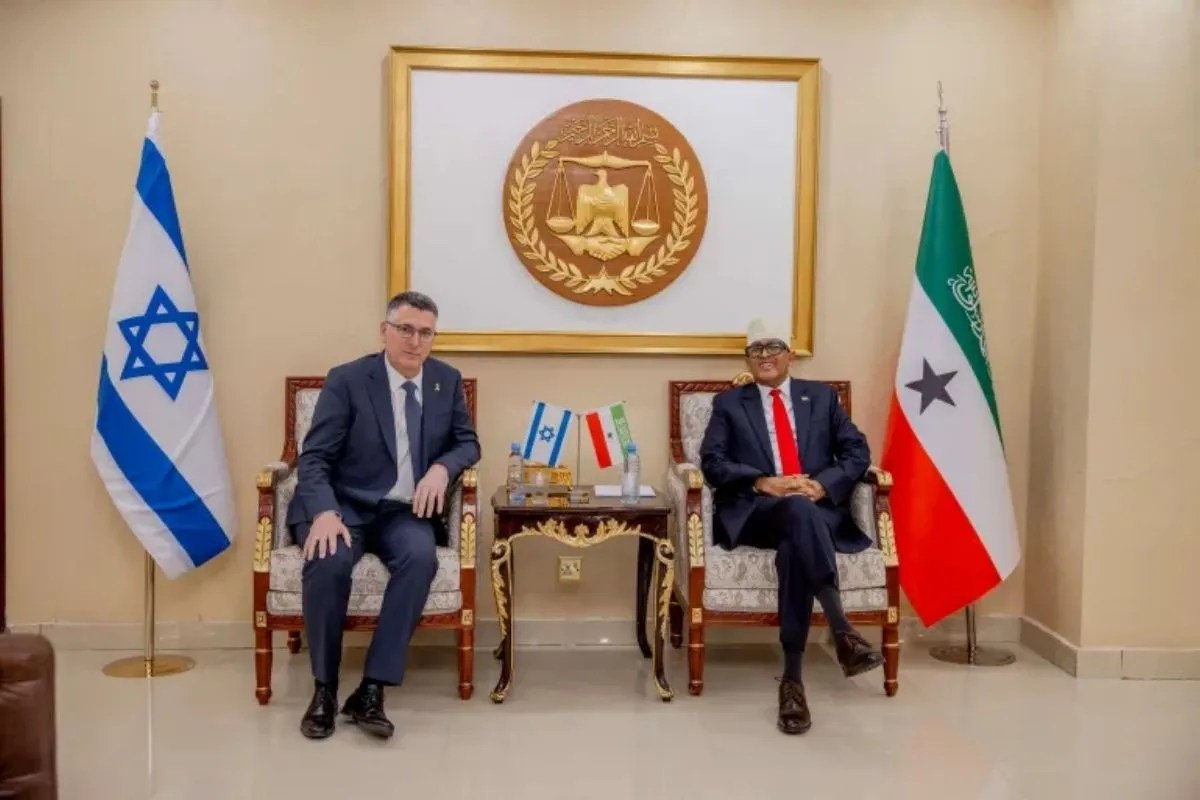
While the world's eyes are glued to the thunderous exchange of missiles and rhetoric between Israel and Iran, a quiet handshake in the Horn of Africa has signaled a seismic shift. Israel has appointed its first-ever representative to Somaliland. This isn't just a routine diplomatic assignment. It is a strategic masterstroke disguised as a handshake, a move that places a chess piece on a board most people don't even realize is active.
The Geography of Survival
To understand why a small, unrecognized territory in Africa matters to a high-tech powerhouse in the Middle East, you have to look at the water. Specifically, the Bab-el-Mandeb Strait. This narrow choke point is the jugular vein of global commerce. If you are sitting in a cafe in Tel Aviv or a boardroom in Haifa, your connection to the world—your fuel, your goods, your security—flows through this needle's eye.
Israel finds itself in a tightening circle. To the north, Hezbollah bristles with an arsenal that keeps the border in a state of permanent tension. To the east, Iran orchestrates a "ring of fire," a long-term strategy of encirclement. And to the south, the Houthis in Yemen have proven that they can disrupt the global economy with relatively inexpensive drones and missiles, targeting ships and bringing the reality of the Red Sea conflict into the living rooms of every Israeli citizen.
Isolation is a slow poison for a nation. Israel knows this. To counter the encirclement, it must look further afield, finding partners who share its predicament of being an outsider in their own neighborhood.
Two Outsiders in the Same Storm
Somaliland is the ultimate outsider. Since 1991, it has carved out a peaceful existence in a region often defined by chaos. While its parent state, Somalia, struggled with decades of civil war and the rise of Al-Shabaab, Somaliland built schools, established a police force, and created a stable environment for business. Yet, the international community, fearful of encouraging secessionist movements elsewhere, has largely turned a blind eye.
Imagine a person who has built a thriving garden in the middle of a wasteland, only to be told by the neighbors that the garden doesn't officially exist. That is the frustration of Somaliland.
Now, consider Israel. Despite its technological prowess and military might, it remains a nation seeking legitimacy and security in a region where many still dream of its erasure.
When these two entities look at each other, they see a reflection. They see a partner who understands what it means to survive against the odds. The appointment of an Israeli diplomat to Hargeisa is a public acknowledgement of this shared DNA. It says: "I see you, and I know you are real."
The Invisible Stakes of the Red Sea
The conflict with Iran isn't just about ideology or ancient grievances. It is about the future of energy and digital connectivity. Underneath the waves of the Red Sea lie the fiber-optic cables that carry the world’s data. If the Houthis, backed by Iranian intelligence, can threaten the surface, they can theoretically threaten the seabed.
Israel’s presence in Somaliland provides a vital listening post. It offers a vantage point over the shipping lanes that the Houthis call their hunting grounds. For Israel, this is about early warning systems and intelligence depth. For Somaliland, it is about the ultimate prize: international recognition and the security hardware required to protect its own coastline from piracy and foreign interference.
The move is a calculated gamble. It risks the ire of Mogadishu and potentially complicates relations with other Arab nations who are wary of any "Zionist footprint" in the Horn of Africa. But the logic of "the enemy of my enemy is my friend" is a powerful intoxicant in the world of realpolitik.
The Human Pulse Behind the Policy
Think of a young entrepreneur in Hargeisa. Let's call him Ahmed. Ahmed has a degree in computer science but finds himself limited by the fact that his country’s banks aren't connected to the global SWIFT system. He watches the news and sees the tech booms in Tel Aviv. He knows that an alliance with Israel could mean more than just soldiers and coastal patrols. It could mean high-speed internet, agricultural tech to fight the encroaching desert, and a bridge to the global economy that has been denied to him for thirty years.
On the other side, consider an Israeli naval officer stationed in Eilat. He watches the radar screens, knowing that a drone launched from Yemen could appear at any moment. For him, a friendly port or a sympathetic intelligence partner in Somaliland isn't an abstract diplomatic concept. It is the difference between a blind spot and a clear view. It is the difference between a successful interception and a tragedy.
These are the lives that hang in the balance when a diplomat packs a suitcase and heads to a capital that most of the world refuses to name.
A New Architecture of Power
The old maps are burning. The idea that the Middle East is a self-contained theater of conflict is dead. We are seeing the emergence of a trans-regional security architecture. It stretches from the Mediterranean to the Indian Ocean. In this new world, the traditional alliances of the 20th century are being replaced by "minilateral" agreements—small clusters of nations joined by specific, urgent interests.
Iran’s strategy has been to use proxies to create a "gray zone" of permanent instability. Israel’s counter-strategy is to create a "blue zone" of maritime and technological partnerships. Somaliland is the newest, and perhaps most surprising, addition to this blue zone.
There is a vulnerability in admitting that you need help. By reaching out to Somaliland, Israel is acknowledging that it cannot hold the line in the Red Sea alone. By welcoming Israel, Somaliland is admitting that its quest for recognition requires powerful, if controversial, patrons.
It is a marriage of necessity, forged in the heat of a looming regional war.
The Silent Change
The streets of Hargeisa remain dusty. The camels still wander the outskirts, and the tea shops are still full of men debating the day's events. To the casual observer, nothing has changed. But in the corridors of power, the air is different.
The appointment of a representative is a signal flare. It tells the world that the Red Sea is no longer a backyard for any single power. It tells Iran that its strategy of encirclement has a leak. It tells the people of Somaliland that their long isolation might finally be nearing an end.
As the sun sets over the Berbera port, the shadows grow long across the water. Somewhere out there, a ship carries goods that will power a city thousands of miles away. It sails through waters that are more contested than they have been in decades. But now, there is a new set of eyes watching over it, joined by a common cause and a mutual refusal to be erased from the map.
The game has changed, and the players are no longer who we thought they were.
The horizon is no longer just a line where the sea meets the sky. It is a frontier where two lonely nations have decided to stand together, waiting for the storm to break.