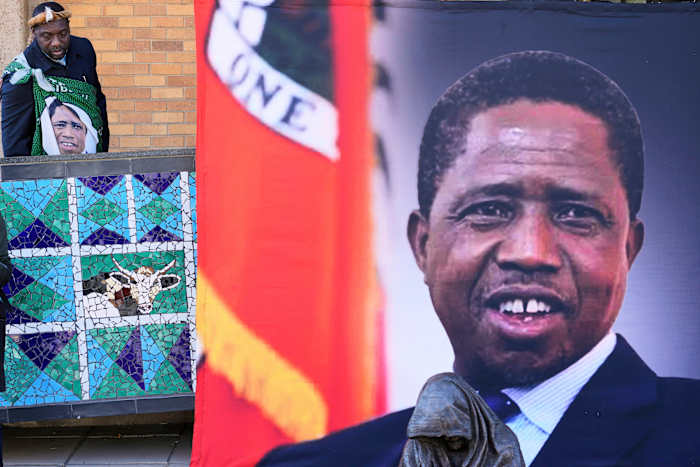
The intersection of constitutional authority, customary law, and the private rights of a former Head of State creates a volatile legal vacuum when a government attempts to nationalize a funeral against the wishes of the bereaved. The current standoff between the Zambian government and the family of former President Edgar Lungu represents more than a "bizarre dispute"; it is a systemic failure of state protocol to account for the Dual Agency of a public figure. When a leader dies, they exist simultaneously as a national symbol (the State Property) and a family member (the Private Individual). The High Court’s order to return the body to a funeral home indicates a breakdown in the state's ability to navigate this duality without overstepping its executive mandate.
The Triad of Conflict Customary Law Statutory Mandate and Human Rights
To understand why a judiciary would take the unprecedented step of ordering the state to relinquish control of a former leader’s remains, the situation must be viewed through three distinct legal lenses.
1. The Customary Prerogative
In many Southern African legal systems, including Zambia’s, the "right to bury" is fundamentally rooted in customary law. Unless explicitly superseded by a written statute, the next of kin holds the primary legal standing to determine the location, timing, and nature of the interment. The state’s intervention relies on the assumption that a former president’s body is a matter of "National Heritage," yet this status lacks a specific statutory anchor that would strip a widow or children of their traditional burial rights.
2. The Presidential Benefits Act
The Zambian government’s logic often stems from the Presidential Benefits Act, which mandates the state to provide a state funeral and a designated burial site (often the Embassy Park Presidential Site). However, a "benefit" is not a "seizure." If the family rejects the state-funded benefit in favor of a private ceremony, the state loses its jurisdictional hook. The court’s intervention suggests the government attempted to convert a financial obligation into a possessory right.
3. The Right to Privacy and Dignity
The African Charter on Human and Peoples' Rights and the Zambian Constitution protect the dignity of the individual. Forcing a family to surrender a body to a state-controlled environment against their will constitutes a breach of the "right to family life." The state’s move to bypass the family’s wishes creates a precedent where the government can effectively nationalize the grieving process for political optics.
Structural Failures in State Protocol
The escalation of this dispute to a High Court injunction reveals three specific operational bottlenecks in the Zambian government’s handling of transition protocols.
The Monopoly of Narrative
Governments often view state funerals as tools for national unity or political legitimacy. When a former president is a leader of the opposition—as is the case with Edgar Lungu—the funeral becomes a contested space. The state’s rush to secure the body aims to prevent the funeral from becoming an opposition rally. This creates a Political Agency Conflict where the government’s desire for order clashes with the family’s desire for autonomy.
The Infrastructure of Custody
By removing the body from a neutral funeral home to a state-controlled facility, the government transitioned from a facilitator to a custodian. This shift changed the legal burden of proof. In a neutral funeral home, the family maintains access. In a state facility, the state dictates access. The court recognized that this change in physical custody effectively "dispossessed" the family of their legal rights before a final determination on the burial site could be made.
Absence of Pre-Need Legal Instruments
A significant contributor to this crisis is the absence of a Testamentary Disposition of Remains. Most leaders focus on asset distribution but fail to codify their burial preferences in a legally binding manner that specifically addresses state vs. private rites. In the absence of a clear written directive from the deceased, the default legal weight shifts entirely to the next of kin, leaving the state with no standing to interfere.
Quantitative Risk of State Intervention
The state’s decision to forcibly manage a funeral carries quantifiable risks that go beyond social "awkwardness."
- Institutional Trust Degradation: Every hour the state defies a family’s wish, the perceived legitimacy of the Executive branch drops among the base of the former leader.
- Judicial Overstretch: When the judiciary is forced to rule on the physical location of a corpse, it risks being perceived as "politicized," regardless of the legal merit of the ruling.
- Security Overhead: Attempting to hold a body against family wishes requires a massive deployment of state security to prevent public unrest. This creates an unnecessary drain on the national treasury for a non-security event.
The Mechanics of the Injunction
The High Court’s order is not a final judgment on where the former president will be buried; it is a Status Quo Ante ruling. The court identified that the government’s "bizarre" removal of the body disrupted the legal equilibrium.
The order functions as a "restraining mechanism" to prevent the state from creating a fait accompli (an accomplished fact). If the state were allowed to bury the body while the legal dispute was ongoing, the family’s right to a hearing would be rendered moot. By ordering the return to the funeral home, the court is re-establishing the family’s role as the primary stakeholders in the decision-making process.
Tactical Path for Conflict Resolution
For the Zambian government to exit this stalemate without further damaging its international standing or domestic stability, it must pivot from a Command-and-Control model to a Collaborative Protocol model.
De-Escalation via Neutral Mediation
The state should appoint a non-political intermediary—ideally a religious leader or a traditional chief respected by both the Lungu family and the current administration. This shifts the dialogue from "State vs. Family" to "Tradition and Respect."
Decoupling Honors from Location
The government can offer full state honors (guards of honor, gun salutes, diplomatic attendance) while conceding on the burial location. A state funeral does not technically require the body to be interred at a state-owned site. By allowing the family to choose the site while the state provides the ceremonial framework, the government fulfills its statutory duty without infringing on private rights.
Formalizing Future Transition Protocols
This dispute highlights a legislative gap. Parliament must introduce an amendment to the Presidential Benefits Act that requires sitting and former presidents to file a "Burial Mandate" with the Chief Justice. This document would act as the final word, preventing the state or the family from weaponizing the deceased’s remains for political or personal leverage.
The immediate strategic priority for the state is the unconditional return of the remains to the funeral home as ordered. Failure to do so transforms a private family dispute into a constitutional crisis, where the Executive is seen as defying the Judiciary. The state’s power ends where the family’s grief begins; recognizing this boundary is the only way to ensure the transition remains a moment of national reflection rather than a catalyst for civil instability.
The government must now prepare for the legal reality that the High Court is likely to favor the next of kin in any final ruling on the burial site. The state's best play is to "graciously concede" by offering logistics for the family's chosen site, thereby reclaiming the narrative of being a magnanimous provider rather than a litigious captor. Any further attempt to use the police or military to secure the remains will result in a permanent fracture in the country's democratic optics and a likely defeat in the court of international human rights.